Search This Blog

Wednesday, February 15, 2012

Matara


                                                         Matara

                                                           image


Matara is the largest town on Sri Lanka’s popular south coast, hosting the terminus of the railway line from Colombo.

Today it is a quiet town, but in past centuries was a thriving port central to the spice and gem trade with the East and Holland. The original town was established on a narrow peninsula in the estuary of the Nilwala River, which was fortified by the Dutch. The original walls still stand, containing some rather dilapidated old buildings dating from the Dutch colonial era.

                                                       image

Matara is scenically attractive, surrounded by paddy fields and tea estates on the fertile river floodplain. The area also boasts some sandy, safe beaches. These assets have ensured that the town is a popular tourist destination.
There are many popular tourist attractions in the city:
Matara Fort was built by the Dutch around the year 1640 and is a fortification of a Portuguese garrison. In the fort, you will find many structures of the Dutch and British era. This fort is built in a shape of a star and was meant to provide additional protection to the main fort across the river.
Dondra or Devinuwara is situated 6 kilometers to the east of Matara. It is a 40m high lighthouse, built in the year 1890 inorder to provide guidance to the shipping route south of Sri Lanka.


                                             image

Some of the interesting places situated nearby Mitara where you can go for an excursion are Weligama, Tangalla, located 48 kilometers east of Matara, is also one of the most pleasant places in the region, where you can enjoy a lazy beach holiday.
Discover Holidays Sri Lanka invites you to Tour Sri Lanka and Travel Sri Lanka to check out the best Hotels in Sri Lanka you can enjoy your Holiday in Sri Lanka.
We have the best Tour Sri Lanka packages online; you can enjoy Tour Sri Lanka and Travel Sri Lanka we provide the best rates for Hotels in Sri Lanka please check our offers and new rates to enjoy your Holiday in Sri Lanka.

Tuesday, February 14, 2012

Dunhinda Falls (Bridal Falls)


Dunhinda Falls (Bridal Falls)

Sri Lanka, in comparison to its size, has perhaps the largest number of waterfalls of any country in the world. Indeed, there are nearly 100 in Sri Lanka over 5-10 metres, the largest being no less than 263 metres high. Several factors are necessary for such an abundance of waterfalls. First, the geological formation of the land has to be such that there is a sharp upthrust of the earth’s surface. Second, the rivers should flow over a hard rock face to minimise erosion. Third, there should be plenty of rainfall to swell the rivers. In Sri Lanka all these factors are satisfied in the central highlands.


Dunhinda Falls is the highest waterfall on the Badulu Oya, at 63 metres, a river that rises in the mountains on the border of the Uva highlands and runs into the Mahaweli river. The fall looks breathtaking, with its water roaring over a rocky ledge and falling splashing with clouds of spray into a pool in the rocks below. It is because of this reason that his water fall is named as Dunhinda Falls in Sinhala meaning “spraying” or “vapor waterfall.”
 
The Dunhinda Falls are located on the Badulla – Taldena Road 5 km north of Badulla. From the main road, you have to walk a kilometre to the waterfall. This path follows the course of the Badulu Oya, which flows at the bottom of the valley through the thick forest. Although clearly defined, the path is sometimes quite rocky, and so the travelers should remember to wear suitable footwear. A good observation spot is available at the end of the path. There is also an ancient cave close to the fall where once was occupied by the Veddas (natives of  Sri Lanka) from Bintenne.

Monday, February 13, 2012

Ratnapura

                                                                       Ratnapura


The gem-mining centre of Sri Lanka is also a major crossroad between southern plains and the hill country to the east. A bustling market city servicing most of the surrounding towns. Many of the prominent gem dealers in Sri Lanka operate from this town. Scenery around the town is excellent and charming.

There is a route to Sri Pada from Ratnapura direction. Excursions include Sinharaja Forest and Uda Walawe Wild Life Park. The route towards hill country is beautiful. The surrounding area is a popular trekking destination and a good place for bird watching. Visit traditional gem mining and cutting operations.


                                        .


Ratnapura lies 101 Km Southeast of Colombo. The scenic route takes you passing paddy fields, rubber plantations and tea estates.
Throughout history, Sri Lanka has been known as a land of gems. King Solomon was said to have procured a great ruby for the queen of Sheba from Ceylon (Sri Lanka's former name). Marco Polo (1293 AD) wrote about the ruby that once graced the Ruwanweliseya Dagoba at Anuradhapura..."a flawless ruby a span long and quite as thick as a man's fist".
Sri Lanka has produced three of the world's largest blue sapphires, including the 'Blue Bell' which adorns the British crown and the 'Star of India', displayed at the New York Museum of Natural History.
A visit to one of the museums or many gem workshops will give you the opportunity to see a variety of precious stone, such as rubies, sapphires, cat's eyes, alexandrites, aquamarines, tourmalines, spinels, topaz, garnets, amethyst, zircons etc. You could also visit one of the gem mines.You could also visit one of the gem mines.

Thursday, February 9, 2012

Sigiriya


           Sigiriya The Palace & Fortress in The Sky

Sigiriya, the spectacular 'Lion rock' fortress, stands majestically overlooking the luscious green jungle surroundings, and is one of Sri Lanka's major attractions.

SigiriyaThis was built by King Kasyapa, a son of King Dhatusena, by a palace consort. As legend goes, King Dhatusena was overthrown and walled in, alive by Kasyapa in 473 AD. Mogallana, Dhatusena's son by the true queen fled to India, vowing revenge.
Kasyapa fearing an invasion built this impregnable fortress at Sigiriya.
When the invasion finally came in 491, Kasyapa rode out to battle in his war elephant.In an attempt to out-flank his half-brother, Kasyapa took a wrong turn, where his elephant got stuck in the mud. His soldiers, thinking Kasyapa was retreating fled abandoning him, and he took his own life.
Sigiriya later became a monastic refuge, but eventually fell into disrepair.

Water Gardens


Sigiriya water garden


The beautifully and elaborately landscaped water gardens, contain a complex network of underground water distribution system, which provides water to the Royal baths, the many little moated islands & fountains, some fountains still work during the rainy season! A superb view of the Gardens could be had from halfway up the rock.

Frescoes - The Sigiriya Damsels

Sigiriya frescoesAbout halfway up the rock is a sheltered gallery of frescoes painted on the sheer rock face. The 'Heavenly Maidens' are similar in style to the paintings of Ajantha in India. Some of them are still in remarkably good condition. Only 22 out of an estimated 500 pictures now remain. Flash photography is not allowed at this site.


The Mirror Wall with Graffiti

Sigiriya mirror wall

Beyond the fresco gallery, the pathway circles the the sheer face of the rock, and is protected by a 3m high wall. This wall was coated with a mirror-smooth glaze, in which visitors over 1000 years ago noted their impressions of the women in the gallery above. The graffiti was mostly inscribed between the 7th and 11th Century AD. 685 of them have been deciphered and published. The graffiti are a great source for the scholars to study the development of the Sinhala language and script.

Lion Platform


Sigiriya Lion platformThe Northern end of the rock the pathway emerges to a platform, from which the rock derives its name Sigiriya (the Lion Rock). At one time a gigantic brick lion sat at the end of the rock, and the final ascent to the summit was between the lions paws and into it's mouth! Today the lion has disappeared, only the paws and the first steps are visible.


The Summit

Sigiriya foundationsCovering an area of around 1.6 hectares, the remains of the foundations show that the summit would have been completely covered with buildings. The design, layout and magnificent views that it still enjoys to this day, suggest Sigiriya would have been more of a royal palace of pleasure than a fortress. A pond scooped out of solid rock measuring 27m x 21m, looks like a modern rooftop pool. A smooth slab of flat stone, often referred to as the kings stone throne, faces the rising sun.

Wednesday, February 8, 2012

            Hikkaduwa coral reef Sri Lanka


The beach of Hikkaduwa is situated 98 km from Colombo towards the south of Sri Lanka. This fun coastal town 14 kms from Galle was the first (1960's) of Sri Lanka's beautiful beaches to be discovered by tourists. Snorkeling and diving in the clear waters are the major past-time along this stretch and is the most environmentally friendly way to see the colorful fish that dart around. The coral sanctuary found on the coast of Hikkaduwa is a large shallow body of water enclosed by a reef, decorated with layers of multi colored corals, witch is home to countless number of colorful fish. Off the beach there is a collection of tine islets surrounded by beautiful coral formations. Many species of fish and large turtles are found here.There are more than four different shipwrecks for diving enthusiasts to explore along with dive shops offering PADI courses and equipment. Plenty of beachfront accommodation and a reputation as the second best surf spot in Sri Lanka by the international board-riding set, and the reason so many visit Hikkaduwa is blatantly clear.

The resort area has now engulfed two or three villages south of it, and is now a 4km strip of hotels, shops, bars, restaurants and guesthouses. The beaches are nice and wide and swimming is safe here, though the currents are stronger south of Hikkaduwa proper. The impressive coral reef runs just offshore and is still populated by exotic fish and sea turtles. Glass bottomed boats are available for visitors wanting to admire the wonders of the deep while keeping their feet dry!

After a shot distance southwards from the center of the reef, it diminishes given rise to a wider sandy bottomed beach with good waves ideal for board surfing and body surfing. You can always rent the necessary equipment needed for snorkeling and surfing. Hikkaduwa is an established tourist destination and the surfing there is quite well known. You won't see the Indonesian style overcrowding here though. The reef is coral so a first aid kit and booties are handy. Localism is usually not a problem though we have seen some tourists get some hassle. Respect them and they leave you alone pretty much. There are many shops selling Masks, Gems, Jewellery, Batik, Antiques and etc. along with several Buddhist temples, all which add spice to life at Hikkaduwa.  


Hikkaduwa, a popular tourist destination in the Galle District is renowned for it's beach and the corals. The Coral Garden here is considered to be the best out of all such coral gardens found in Asia. There is a reef of lime stones running parallel to the coast. The corals are in between this line of lime stones and the coast. The sea up to about 200 m from the coast is very shallow. The reef of lime stones protects the corals from high tide. The coral type found mostly here is the type locally called "Gampara". These corals are found in various forms , shapes and colours. They are a very fascinating sight especially when there is bright sunlight which gives a very clearer view of the corals. You see some corals in the shape of a cabbage leaf; some are like a lady's fan. Since there is no silt, corals can grow in their natural form and colour.


Wednesday, February 1, 2012

    Sri Lanka Animals

  What a fantastic place Sri Lanka is for seeing many of the wild animals of the Indian Sub-continent!  This island-country off the southeastern coast of India is home to Asian elephants, leopards, monkeys, mongoose, sloth bears, jackals, Sambar and chital deer, water buffalo and wild boars.  Reptiles  and amphibians include crocodiles and venomous snakes such as kraits, vipers and cobras, plus the more friendly geckos, frogs, and lizards.  Birdlife is extraordinary (and we've given birds their own web pages).  Unfortunately, of the more than 80 species of mammals in Sri Lanka, at least 22 are threatened with extinction.  Habitat destruction by deforestation and water pollution is the main threat to these animals. The on-going civil war has led to more destruction especially in the north where rebels have poached animals for food.
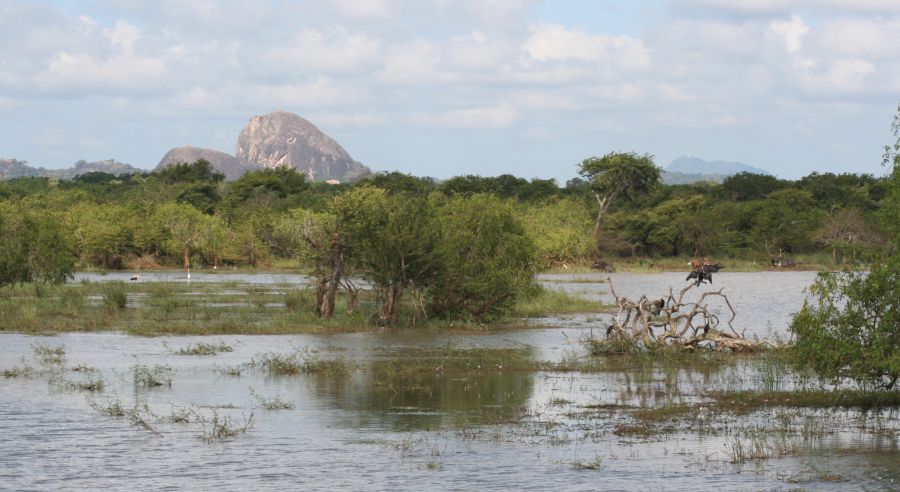
Elephant Rock & wetlands in Yala National Park
As we traveled by rail and road throughout the Sri Lankan hills and along the coast we saw troops of wild macaque monkeys, numerous birds (especially water birds in the marshes), working elephants in the fields, and domesticated water buffalo.  The best animal viewing, however, was in Yala National Park on the southeastern coast of the country.  One of about 10 major national parks, Yala is particularly accessible to travelers and has not had the problem with poaching that some of the more northern parks have had due to the on-going civil war.  Visitors to the parks contribute much-needed revenue and play a vital role in helping spread the word about the Sri Lanka's vast and varied wildlife.
Birding is excellent in the hills, and around the lagoons, marshes and waterways of the coast, and certainly in Yala National Park with its dry scrub, rivers, and wetlands.
Photos were all taken in Yala National Park.

MAMMALS

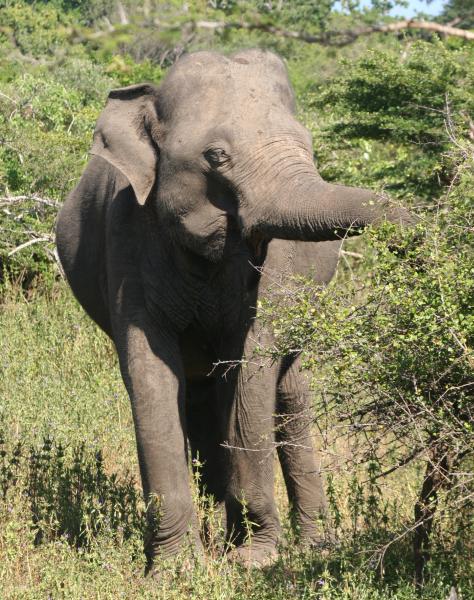
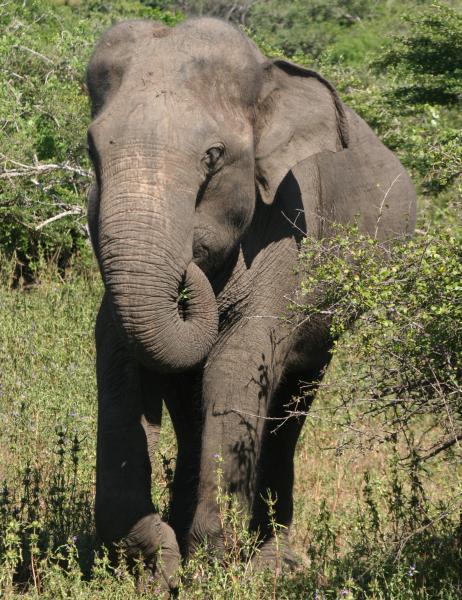
Elephant Feeding in Yala National ParkElephant approaching us in Yala NPLargest, and perhaps best known of the Sri Lankan wildlife is the Asian Elephant Elephus maximus.  The Asian elephant differs from its cousin, the African elephant, in several ways: the Asian is smaller, with shorter ears, a single (not double) "finger" at the end of the trunk, a more rounded back, and 4 nails, instead of 3, on its hind feet.  It also has a personality that allows it to be domesticated.  That is not to say that when a wild elephant chooses to cross your path in a park you don't get out of its way -- you do!  Even in a big vehicle!  Sir Lankan elephants don't carry a lot of ivory: most females and many of the males have no tusks at all. Asian elephants live in groups of about 10 animals led by older female.  Young males are banished from the group to fend for themselves, although they often form small bachelor herds.
Their are 2 subspecies in the country: Elephus maximus maximus (the Ceylon elephant) and Elephus maximus vilaliya(the Ceylon marsh elephant) and both are listed as endangered.  It is estimated that there are perhaps 2500 wild elephants in the country now, as opposed to over 12,000 in 1900.  Most live in 7 of the 10 major national parks.  Wild elephants that venture into farmlands can sometimes be transported to the parks to live.
Both subspecies are listed by the World Conservation Union as threatened.

Leopard hiding behind brush
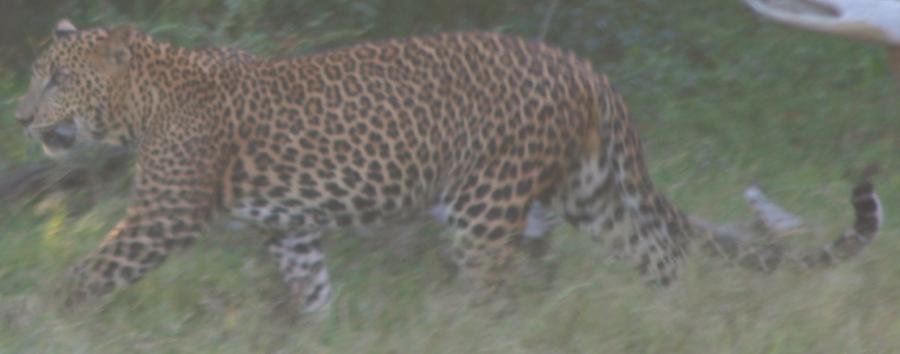
Leopard stalking a water-buffalo, but he didn't try very hard
At about 5pm, just an hour before sunset, we were rewarded with a sighting of a Sri Lankan Leopard Pantera pardus kotika in Yala National Park.  With only about 35 leopards here, it was quite thrilling!  We first saw him (or her) in the bushes by the side of the road where another 4WD vehicle had stopped.  We tried to get a photo, but couldn't.  The leopard began walking west through the bush, and then, before the other vehicles moved, our driver backed up and took a side track hoping to intersect the leopard on its path.  He was right on!  We watched as this beautiful animal hid in the bushes (left), keeping us in view, then ambled across the dirt road to the edge of a pond.  Spotting a water buffalo ahead, it put on a burst of speed (photo right), but didn't pursue for long.  Instead, it decided to climb a huge tree and drape itself over the branches, four legs and long tail swinging freely.  Then, with a bit of hesitation but skill it descended the tree head first and walked sedately back into the brush.  Fantastic! We had over a half an hour of leopard watching!  Sri Lanka's leopards are endemic to the island and are listed by the World Conservation Union as threatened.
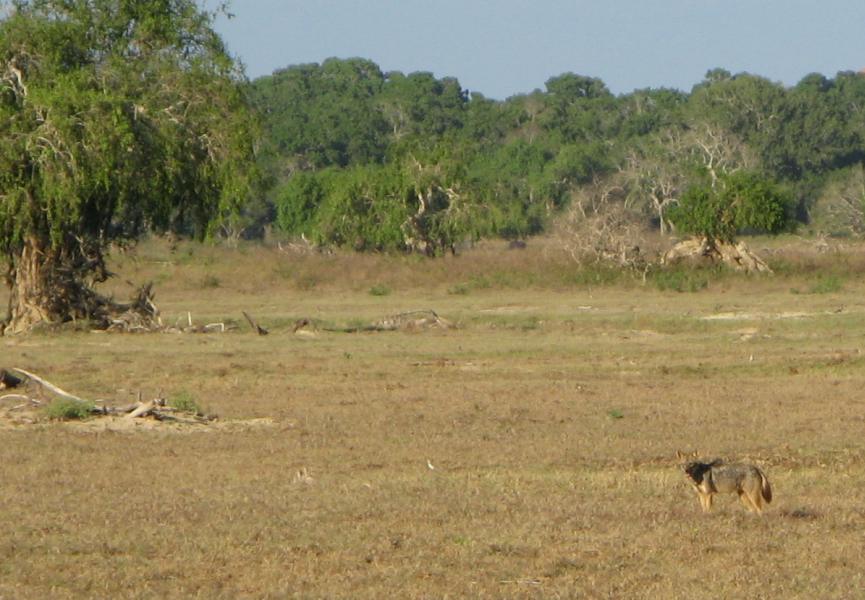
A Golden Jackal blends into the grassland.
Photo by Chris Hacking, Yala National Park
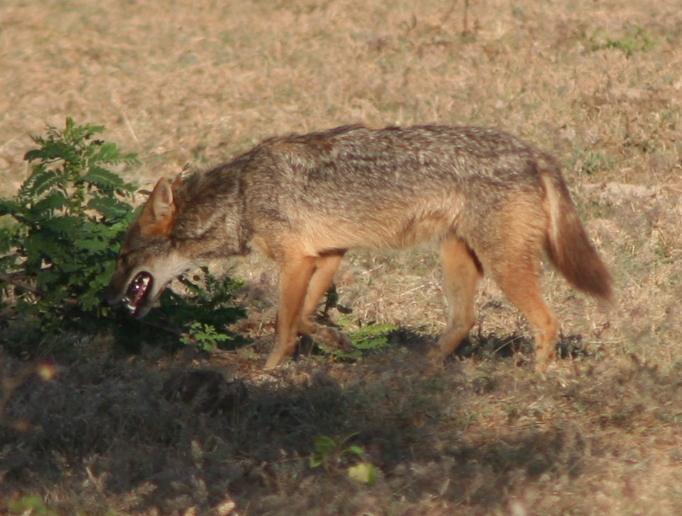
We were busy watching a herd of wild water buffalo in an open grassland in the late afternoon in Yala National Park when someone said, "What's that?"  Walking across the grass were two small dog-like animals that blended in so well we had to blink to be sure they were there.  The Golden Jackal Canis aureus is usually nocturnal, and may hunt alone or in packs to take down Chital deer.  How lucky we were to see these shy, wily creatures on our day-time visit to the park.  Visitors who sleep at one of the park bungalows may hear the jackals calling as they gather in packs for hunting.  Jackals are opportunistic hunters taking mammals, insects, birds, frogs, small deer and carrion.
A Jackal checks a bush for small prey.
Photo by Amanda Hacking

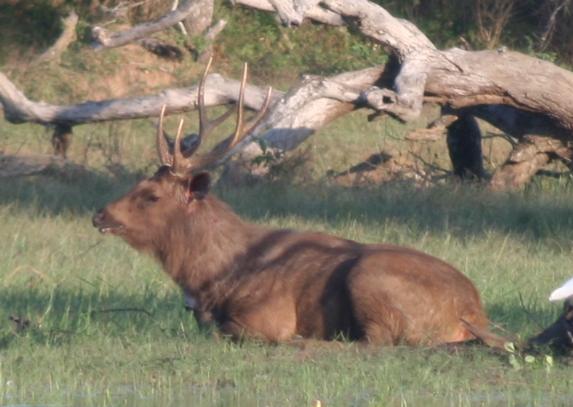
Even seen from afar, the brown, shaggy bulky body of the Sambar Deer Cerbus unicolor stag (right) is unmistakable.  Here, a stag with antlers rests in a field in Yala National Park.  Active at night, the deer are often seen resting near water during the day.  Males develop antlers each year prior to rutting season in November or December.  They perform ritualistic fights with other males.  Mature females, called hinds, lead groups of 10 to 20 deer. These large deer stand 1 to 1.5m (40 to 63in) at the shoulder and can weigh up to 270 kg (600 lbs).A Sambar deer stag

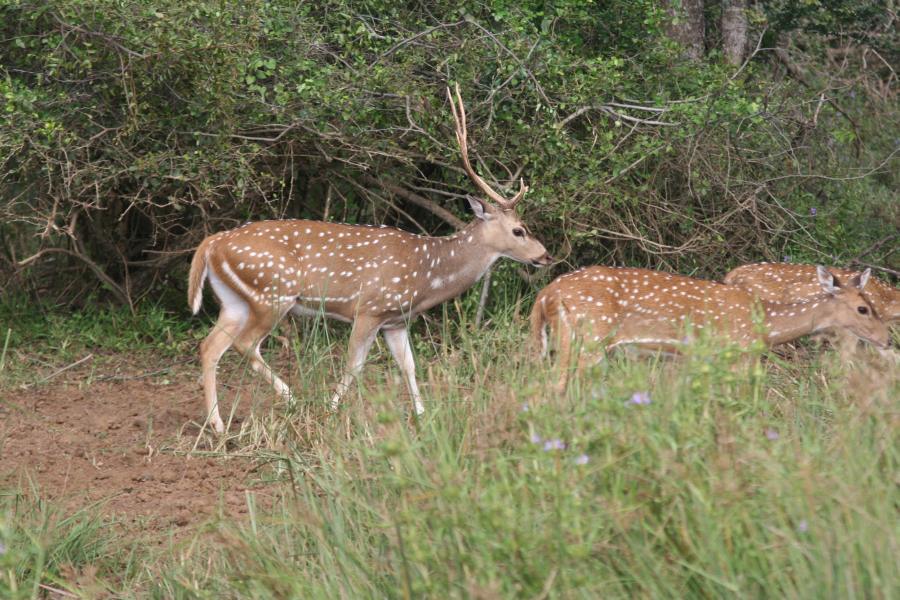
A Chital deer family group with adult male
Adult male Chital deer travel with the herd.
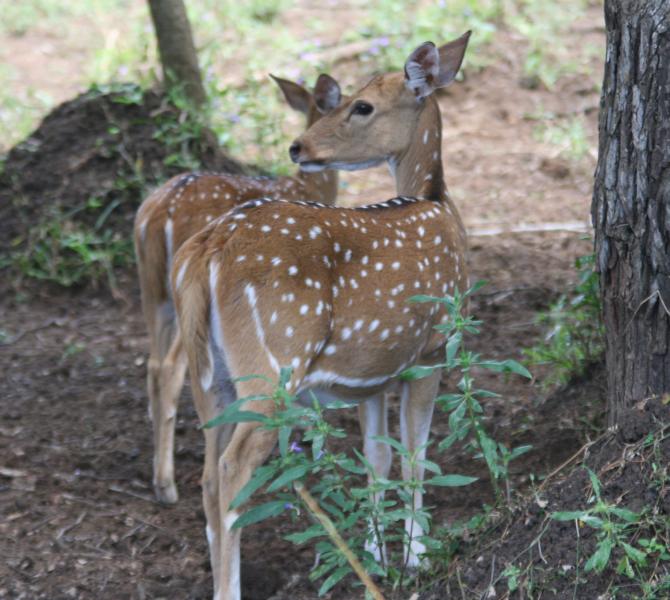
Sri Lanka's other deer is the graceful, light reddish-brown and white-spotted Chital Deeraka Axis Deer Axis axis.  These lovely animals look like big versions of Bambi -- in other words they look like large fawns of deer from the Americas!  The Chital deer congregate in groups of 20 of 30 animals but unlike the Sambar Deer, the group usually includes 2 or more adult males (see left).  They tend to graze in open forest or on the edges of forest and grassland.
Lovely female and young Chital Deer
Lovely spotted Chital Deer in Yala NP

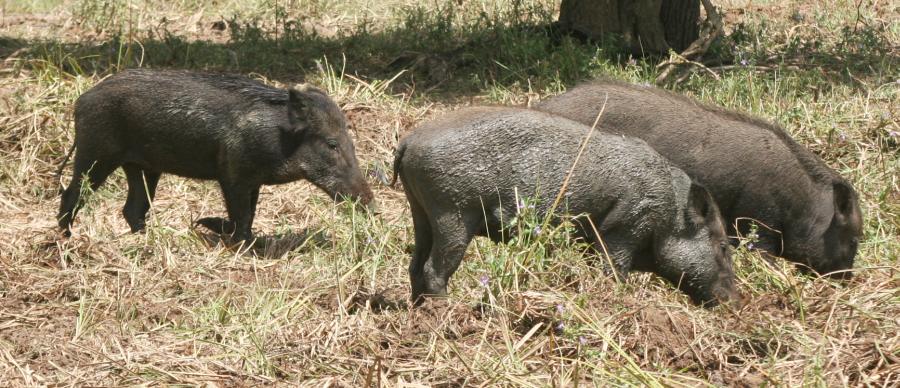
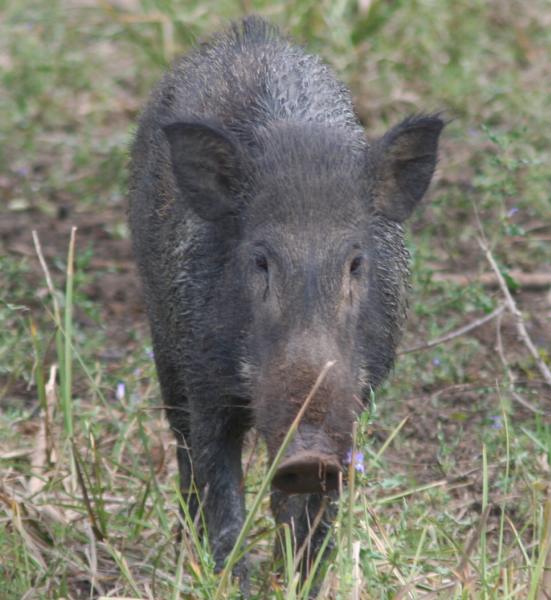
A family of wild boarsTrotting about the edges of marshes and across fields, families of Wild Boars Sus scrofa are a common sight in the national parks of Sri Lanka.  These animals are similar to the European wild boars, but less hairy.  Both males and females can carry short, strong tusks which they use for defense and for digging. Boars are omnivorous, eating roots, nuts, fruits and even small animals.  They can weigh over 150 kg (330 lbs).A young wild boar, head on

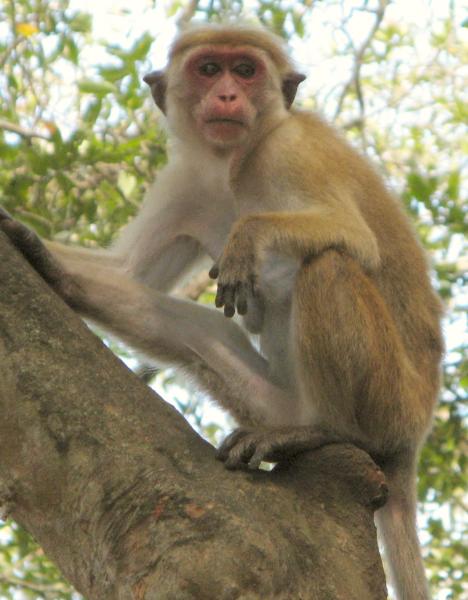
A Red Faced Macaque in Yala National Park
This macaque watched us
eating lunch. (Photo Chris Hacking)
Omnipresent in Sri Lanka are the inquisitive, playful, always-hungry, opportunistic Red Faced Macaques Macaca spp.  They can be found around homes, temples, shopping centers, roadsides and in their more natural state in the wildlife sanctuaries.  Like other macaques, these monkeys have differentiated thumbs, cheek pouches for storing food and hardened bare patches on their rumps called callosities.  Red Faced Macaques adults can grow to about 1m (39in) long with a tail of equal length which they use for balance and as a fifth limb to help when climbing or walking tree limbs or wires.  They have reddish faces and and overall tan/cream colored fur with pointed black ears.  Macaques are omnivorous and can be found near garbage dumps or begging junk food from drivers by the road.  In the wild they eat leaves, berries and small animals.  Living in troops ranging from a few to many animals, both the males and females have important roles such as keeping watch or caring for the young, depending on their dominance.  Often while the females care for newborns males will watch over the older youth.Increased association with humans has led these intelligent animals to mimic human behavior and to become brazen in snatching food, hats, cameras and other unattended items.  A bite by a macaque can be quite dangerous not only for bacteria but the possibility of rabies.  It is best to guard your food and personal items closely when around the monkeys but if they start to take food, do not snatch it away or tease the animal.

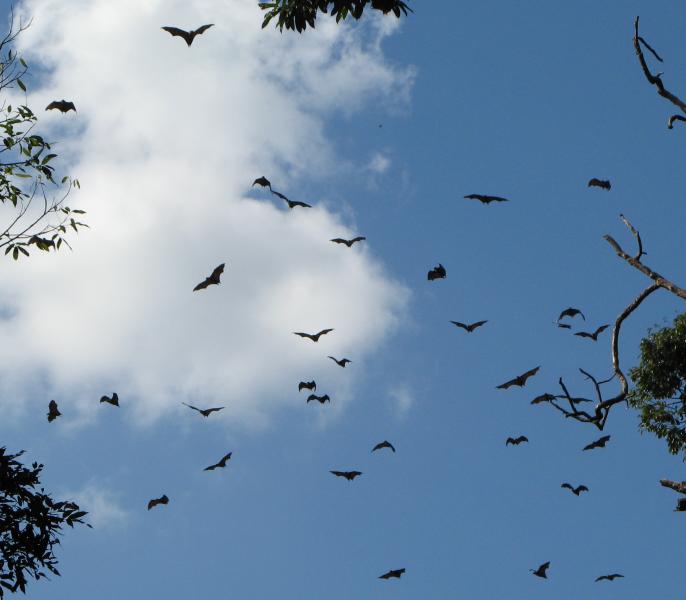
Near sunset the flying foxes take to flight for a night of fruit & nectar feeding
Near sunset the flying foxes take flight
for a night of fruit & nectar feeding
A camp of roosting flying foxes in the Botanic Garden near Kandy.
A camp of roosting flying foxes in the
Botanic Garden near Kandy.
Screeching and chattering, Sri Lanka's Indian Flying Foxes Cynopterus marginatus (probably) make a racket in the trees overhead in the hills near Kandy.  Known as "flying foxes" for their lovely fox-like faces and light brown fur, they take on a more ominous look when then wrap themselves in their black, shiny wings or take flight like someone's worst Dracula nightmare overhead.  But these bats are not blood-suckers.  They are fruit-eating bats who use their acute eye-sight to find food.  (Most Old World Fruit Bats use vision, not echolocation for direction finding.)  The  Indian Flying Foxes have a wingspan of about 1.2m (47in) and they roost during the day high in the trees, taking flight in late afternoon for a night-time of fruit hunting.  They are not protected internationally, which they should be as they are hunted for food, destroyed as pests in farmland, and sometimes kept as pets in cages.  Many tropical plants such as bananas, cloves, mangoes, breadfruit, cashew nuts survive due to pollination or seed droppings from the bats.

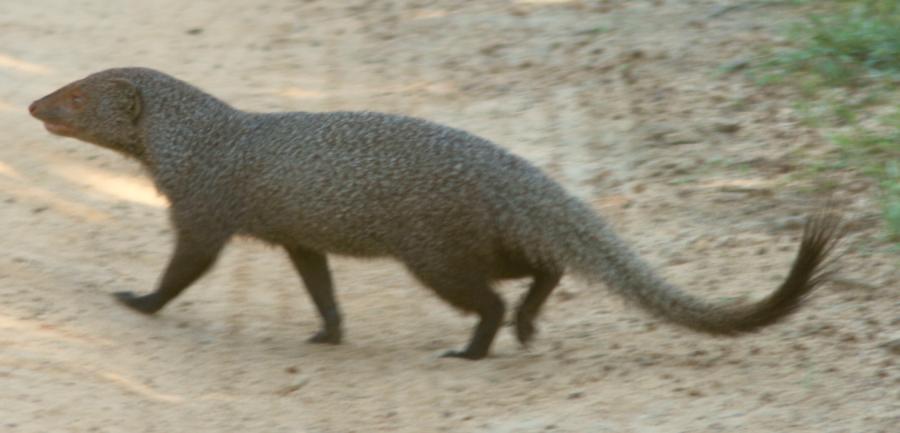
The Indian Mongoose Herpestes edwardsi is a sleek, fast-moving predator.  Hunting either alone or occasionally in pairs, the mongoose eats birds, snakes, eggs, frogs, small mammals and even fruit.  Mongoose hunt by either day or night, and can usually be seen as they run, or almost slither across a road or other open space.  They have a thick coat of speckled gray hair, a long muzzle and tail, and a mouth full of strong, sharp teeth.  They do attack even the most poisonous of snakes such as the cobra, but they are not immune to the venom.  Instead they use incredible agility to avoid being bitten.  They live about 7 to 12 years and have litters of up to four young.
An Indian mongoose rapidly crossing a dirt road in Yala National Park
An Indian mongoose rapidly crossing a dirt road

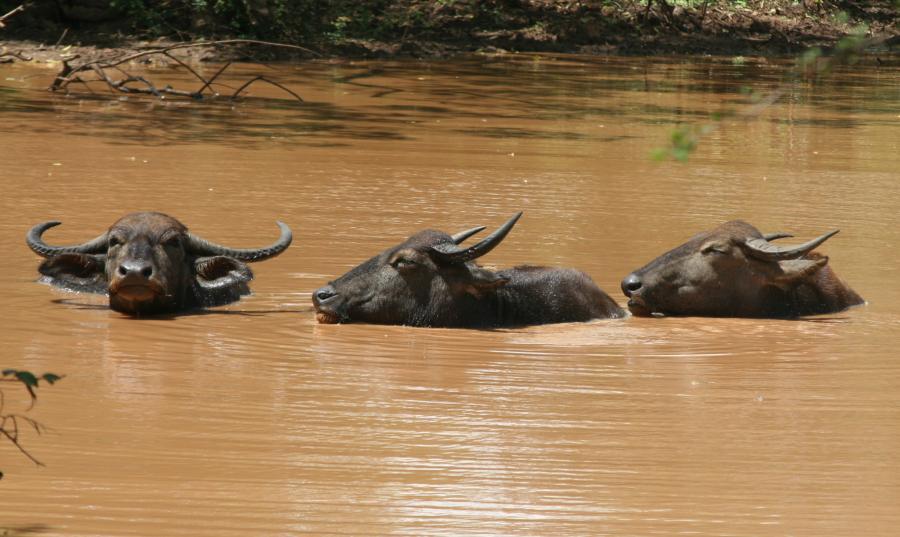
Water buffalo cooling off in a muddy pond
As their name implies, Water Buffalo spend
a lot of time in the water.
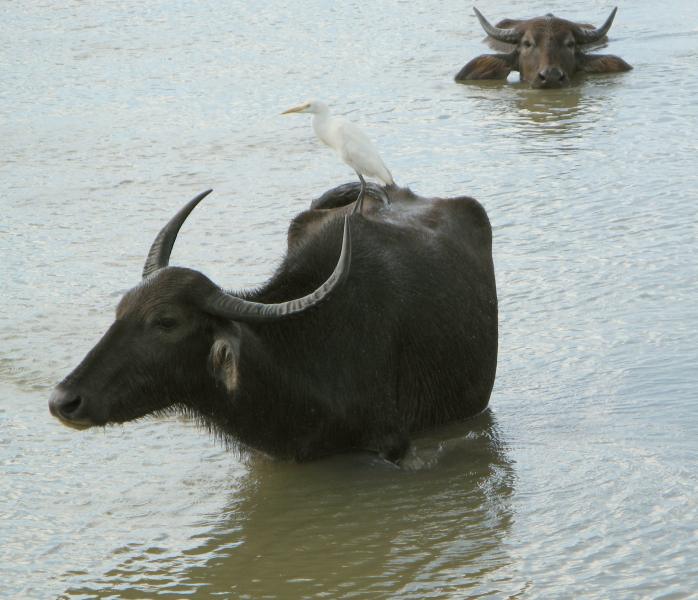
Not nearly as ferocious as their African cousin, the Cape Buffalo, Sri Lanka'sWater Buffalo Bubalus bubalis can still be dangerous when provoked.  With their wide, splayed hooves good for walking in marshes and mud, they can be found just about anywhere there is water.  These animals have been domesticated throughout Asia, and for millennia have been used for plowing and milk production.  They can attain 1.8m (6 feet) at the shoulder, and are larger and more powerful than cattle. Water buffalo co-exist happily with several small birds such as the cattle egrets (right) and some small herons which hitch rides on their backs and remove ticks from their skin. (Photo right, Christopher Hacking)

A water buffalo with cattle egret on its back
A cattle egret perches atop a buffalo

REPTILES
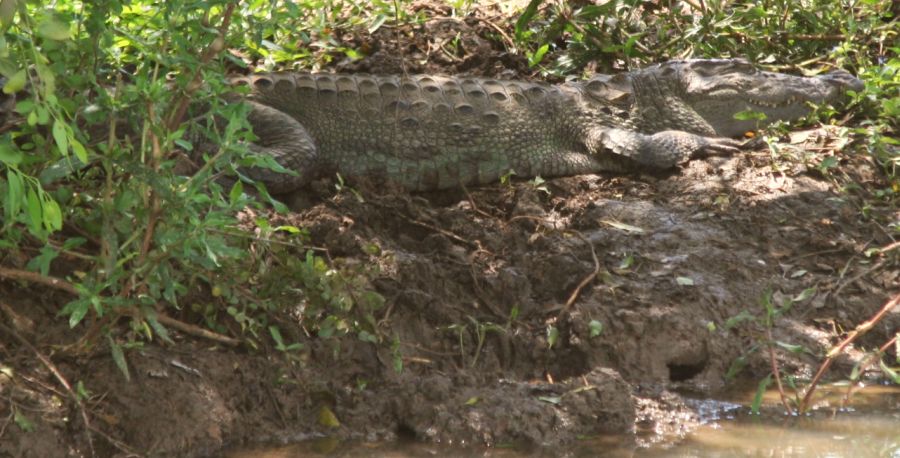
A Mugger Crocodile camouflaged on the bank of a pond
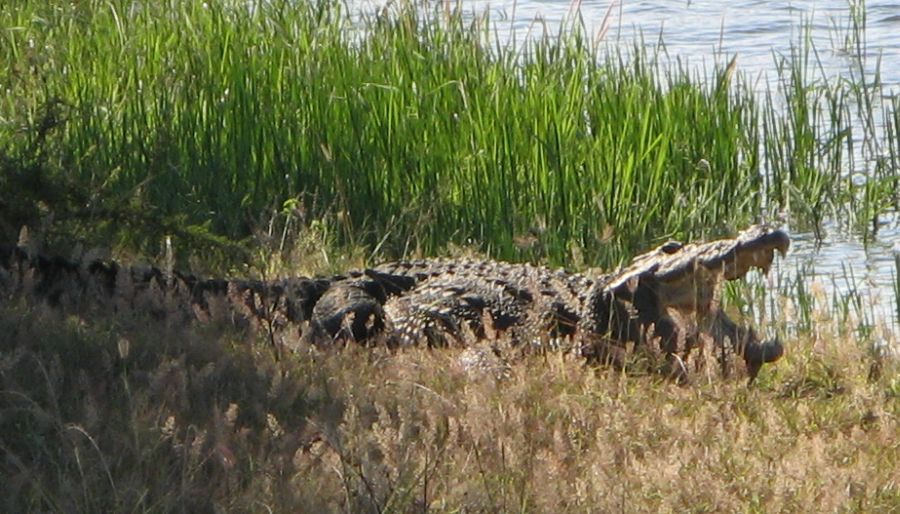
A Swamp or Mugger Croc in Yala National Park, showing its teeth
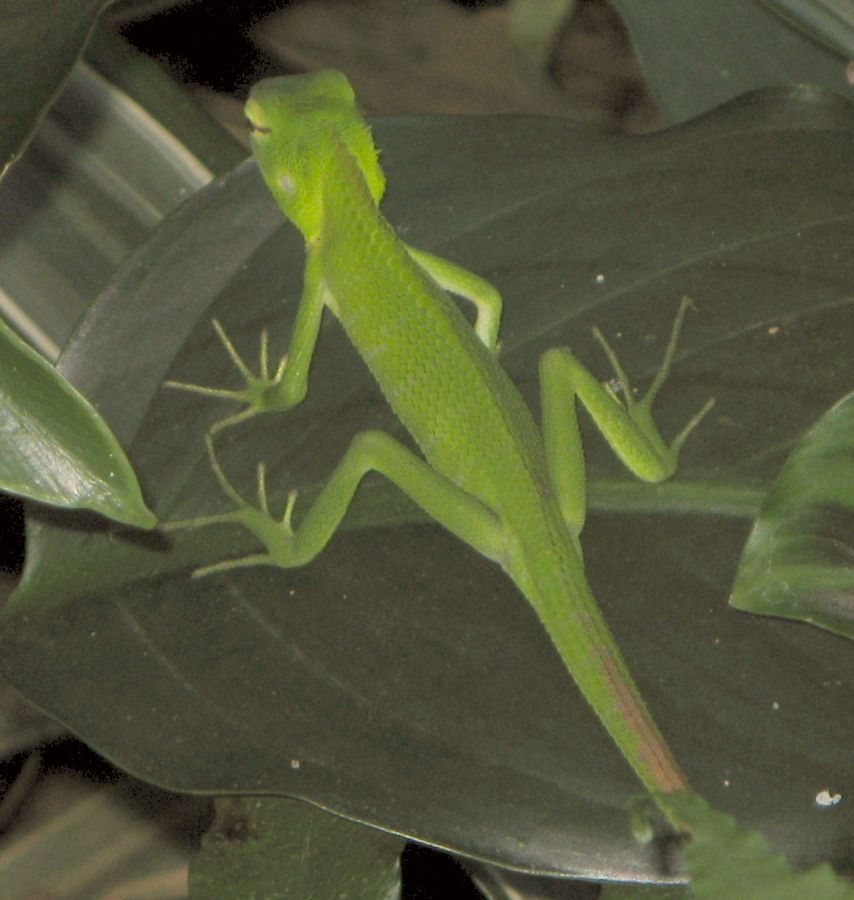
A small green lizard that we don't have the ID on.To the right is an unidentified little green lizard we found in the Botanical Garden near Kandy.  Anyone know what it is, or anything about it?  We have no ID book for small reptiles.Not so hard to ID, though, is the large Mugger or Swamp Crocodile Crocodylus palustris(left) which can be found, if you look closely, on the edges of lakes, marshes and wetlands throughout the country.  Blending easily into the brown mud or grasslands, this inland crocodile spends part of its day in the freshwater and part in the sun.  Not as large as the Indo-Pacific or Saltwater crocodile which inhabits the sea coasts of Australia and Asia, the Mugger is still a formidable predator.  Swamp crocodiles feed on birds, amphibians, and small mammals such as young deer.
During mating season they become quite sociable and you might see a lot of them draped all over each other.  Apparently they are capable of traveling long distances to find water if their current pond or marsh dries up.  They're not something you'd want to stroll along the road with!

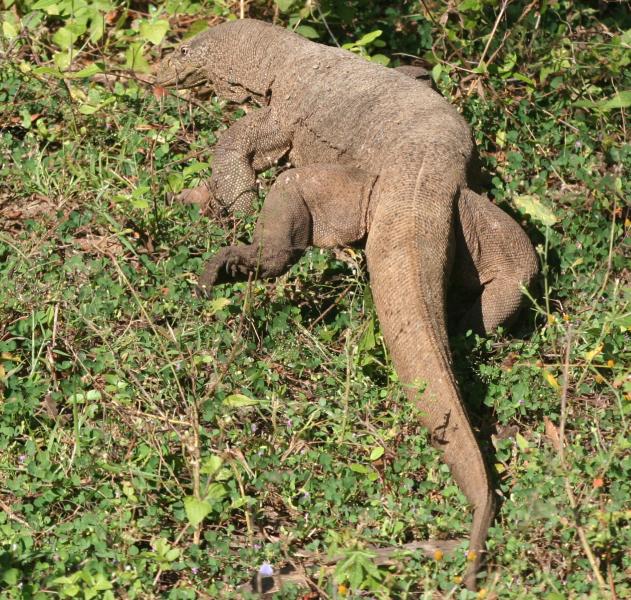
Land Monitor lizard crossing a roadAmbling across the red dirt road in Yala National Park was one very large reptile, which we quickly identified as Sri Lanka's Land Monitor (not yet sure of the Latin name).  There are about 30 species of monitors, including the world's largest, the Komodo Dragon of Indonesia.  Smaller than the Komodo, Sri Lanka's monitor
 can climb trees. All monitors run fast in pursuit of prey, which include small mammals, reptiles, insects, birds and carrion. A long split tongue (visible in the photo to the left, by Jon Hacking) is used to sense/smell prey.  We estimated the length of this monitor to be about 2m (6.5ft).
Land Monitor lizard in the brush